
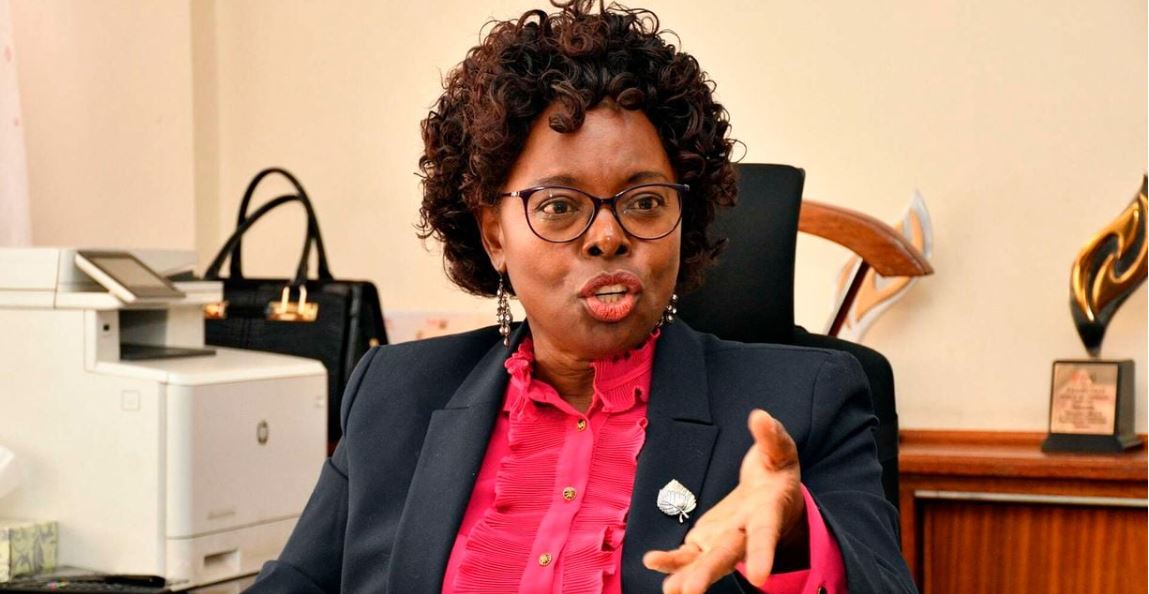
 Budget Controller (CoB) Margaret Nyakang’o has warned that the government is still borrowing beyond approved fiscal ceilings, a trend that threatens Kenya’s long-term fiscal sustainability.
Speaking on Tuesday, July 28, before the National Assembly’s Public Petitions Committee, Nyakang’o said Kenya’s public debt has risen to Ksh.12.82 trillion.
She further accused county governments of diverting funds allocated by her office toward projects and expenses that were not originally requested. According to the CoB, this has entrenched a harmful cycle in which the government is compelled to keep borrowing just to finance its day-to-day operations.
“The total public debt stands at Ksh.12.82 trillion. 60 percent is domestic and 40 percent is external. The impact is that 71 per cent of the revenue collected goes to loan repayment, leaving us with only 29 per cent to finance government operations,” she stated.
“We cannot survive. The impact is that we will continue borrowing for us to survive. We can mitigate it, but how we do that is upon us to figure out.”
Nyakang’o at the same time defended her office’s push to make budget information available to the public, saying expenditure reports are posted online regularly for public scrutiny.
“We publish and publicize. We put them on websites in a downloadable format, and the media always download and analyze them. I thank the media for supporting me. I agree that we need to increase our digital presence and become more active to inform our young people as well,” she said.
She added that her office continues to prioritize stronger public financial management, stressing that accountability improvements must be ongoing.
“Success is not a destination; it is a journey. We have focused on how we are going to improve things,” she remarked.
Nyakang’o also raised alarm over the continued buildup of pending bills by county governments, accusing some counties of redirecting money released to clear supplier claims.
“They let me down. When releasing the funds, they go and do different things with the money. The Central Bank and my office are working on a formula that I hope will work,” she noted.
Nyakang’o said her office has continued to receive numerous complaints from suppliers who say they still have not been paid, even after county governments request and receive funds intended to clear those obligations.
“We are handling a lot of complaints from suppliers who have not been paid. Their details are used to source funds, but when the funds are released, they are redirected by counties to do something else,” she told the committee.
She warned that counties must stop rolling over pending bills from one financial year to the next, adding that her office will introduce tighter oversight before the next general election.
“Pending bills are being left year after year. This year is the final year before the next administration comes in, and we will be very strict on pending bills,” Nyakang’o said.
Nyakang’o also acknowledged efforts by some counties to improve their financial management. She singled out Makueni County for receiving a clean audit report, while noting that others had made gradual progress.
“Makueni last year got a clean report. Some improved from very bad to bad,” she observed.
Nyakang’o reiterated that funds approved for supplier payments must reach their intended beneficiaries, saying she has limited influence once the money leaves her office.
“We want that when we release money for suppliers, they are paid. I am becoming helpless. Counties requisition money for a particular matter; when I approve and release the funds, they are channelled to other uses not authorised. They are budgeted for, but when the money is released, it is taken to another use,” she said.
The post Kenya Public Debt Hits Ksh12.82 Trillion as CoB Issues Fresh Warning appeared first on Bossnana.


