
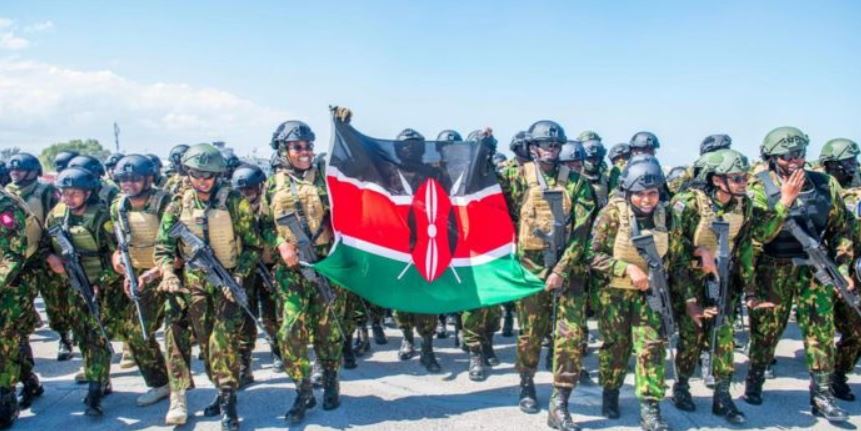
 The government has welcomed the United Nations Security Council’s (UNSC) decision to authorize a new multinational Gang Suppression Force (GSF) in Haiti, which will take over from the Kenyan-led security support mission.
The UNSC move comes at a time when Haiti is grappling with intensifying gang violence, rampant human rights violations, and a humanitarian crisis that has disrupted nearly every aspect of daily life.
Foreign Affairs Principal Secretary Korir Sing’Oei described the transition as timely and encouraging.
“The unanimous adoption of Resolution 2793 (2025) last night by the UN Security Council is a welcome development in the pursuit of a more peaceful and secure Haiti,” he posted on X.
He emphasized that Kenya played a central role in shaping the resolution, noting the country’s experience in leading the MSS and its awareness of the difficulties the Mission encountered.
“Having led the MSS and cognizant of the challenges the Mission faced as recently articulated by President William Ruto at the 80th UNGA, and having co-sponsored Resolution 2798 in her capacity as a member of the Standing Group of Partners.”
Questions now linger over Kenya’s role in the new GSF. According to Sing’ei, “this is a policy decision to be made in due course and will be communicated.”
The new Gang Suppression Force (GSF) will include 5,500 police and military officers, backed by a UN Technical Office that will take full responsibility for tasks such as logistical support and resource mobilization.
A newly established UN Support Office and the Organization of American States will also provide additional backing.
The UNSC authorized the GSF for 12 months, approving it in a Tuesday vote that saw 12 members in favor and three abstentions. Russia and China, both holding veto power, chose to abstain.
Kenya had already deployed its police officers to Haiti in June 2024.
Like the MSS, the GSF will operate under a force commander. However, this time the mission will fall under the oversight of a coalition of willing, troop-contributing countries.
The force will also report to a special representative – a civilian tasked with providing oversight and political guidance.
The special representative will also coordinate with the UN and the Organization of American States (OAS) to oversee the deployment package, ensuring it strengthens joint operations between the GSF and the Haitian police. This support will include building operational facilities and security infrastructure to improve joint planning and oversight by both forces.
The new Gang Suppression Force (GSF) will cap its personnel at 5,550, consisting of 5,500 uniformed officers – both military and police and 50 civilians.
While the GSF will still depend on voluntary contributions to cover personnel costs, the UN Support Office will manage its operations and logistics, including the U.S.-built base in Port-au-Prince.
The post Haiti Security Mission Restructured as Kenya Bows Out of Lead Role appeared first on Bossnana.


